
Nihon Kohden · Patient monitoring
Life Scope G5
CSM-1501 / CSM-1502
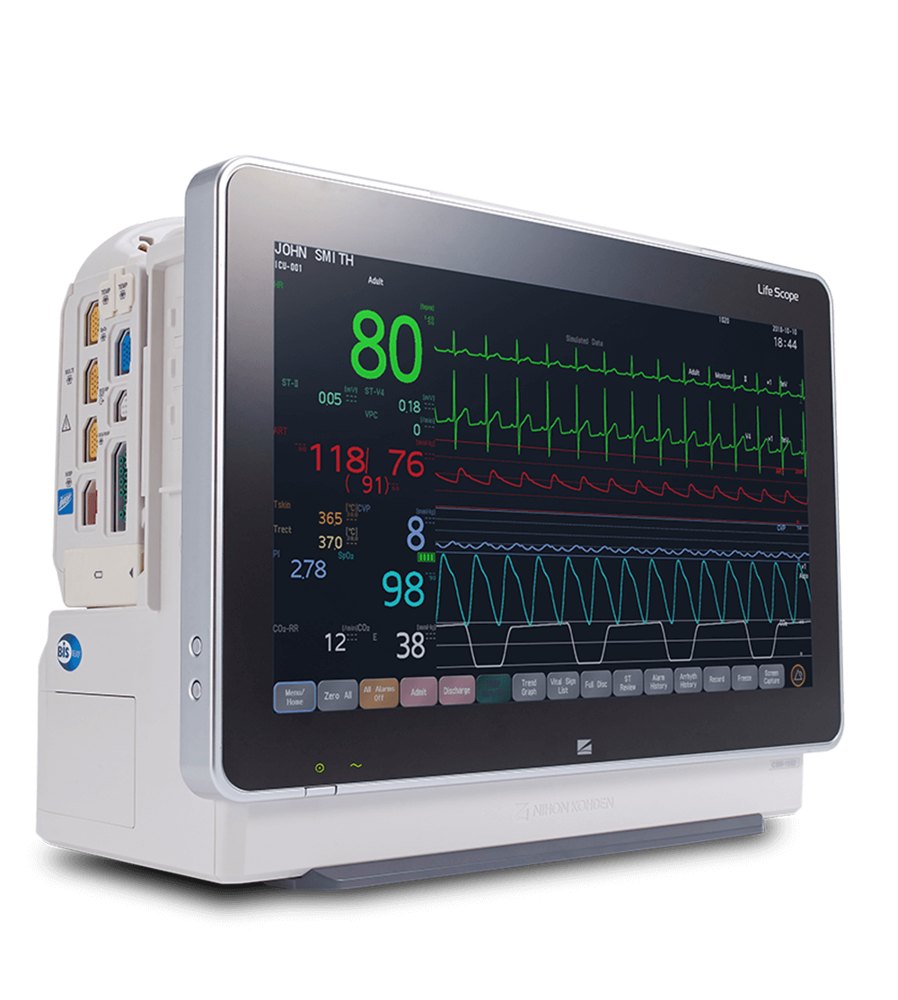
Bedside monitor with a 12.1-inch (CSM-1501) or 15.6-inch (CSM-1502) touchscreen, MULTI connections with Smart cables, HL7 output and transport function.
- Screen size
- 12.1 inch (CSM-1501) / 15.6 inch (CSM-1502)
- Network
- LS-NET, HL7 output
- Battery life (2 battery packs, indicative)
- 5 hours (CSM-1501) / 4 hours (CSM-1502)
- Price
- On quote
For owners of this device
Do you have this device?
Choose what you need. We fill in Life Scope G5 for you.
The Life Scope G5 (CSM-1501/CSM-1502) is a bedside monitor from Nihon Kohden for continuous monitoring, recording and alarming of multiple physiological parameters in adults, children and neonates. The monitor has a 12.1-inch (CSM-1501) or 15.6-inch (CSM-1502) touchscreen and measures additional parameters via MULTI connections with Smart cables.
Via LS-NET and HL7, the monitor can be connected to central monitors and the hospital network; with the transport function, patient data can be taken along with the input unit to another bed.
Specifications
- Type
- Bedside monitor, CSM-1500 series (Life Scope G5)
- Models and core unit
- CSM-1501 (core unit CU-151R); CSM-1502 (core unit CU-152R)
- Intended use
- Continuous monitoring, recording and alarming of multiple physiological parameters of adults, children and neonates in the operating theatre, recovery room, ICU, CCU, HDU, NICU, ED, general ward and other departments.
- Screen size
- CSM-1501: 12.1-inch colour TFT LCD; CSM-1502: 15.6-inch colour TFT LCD
- Resolution and touchscreen
- CSM-1501: 1280 × 800 dots, resistive touchscreen; CSM-1502: 1366 × 768 dots, capacitive touchscreen (direct bonding)
- Additional screens and traces
- CSM-1501: 1 additional screen via HDMI (1366 × 768); up to 15 traces on one screen, 30 on two. CSM-1502: up to 2 additional screens, the first via HDMI (1366 × 768), the second via DVI (1680 × 1050; requires optional side option board QI-152P); up to 15, 30 or 47 traces on one, two or three screens.
- Operation
- Touchscreen, mouse, remote control and barcode scanner. The wireless remote control RY-910PA has six function keys for preset screens; one remote control can operate up to 9 monitors by channel selection.
- Measured parameters
- ECG (3/6/12 leads), respiration (impedance method), SpO₂, SpO₂-2, NIBP, IBP, temperature, cardiac output, BIS, CO₂ (mainstream), TOF.
- Optional parameters
- With optional module/unit: CO₂ (sidestream), anaesthetic gas (CO₂, O₂, N₂O, agent), Flow/Paw, EEG. With external device and interface: ventilation, CCO, SvO₂, tcPO₂/tcPCO₂, rSO₂. With optional software QL-005P/QL-006P: esCCO.
- ECG and arrhythmia
- Arrhythmia analysis with multi-template matching (2 analysis channels), 25 arrhythmia alarm items; ST measurement; QTc/QRSd; 12-lead analysis. Synthesised 18-lead ECG (synECi18) with optional software QL-004P.
- NIBP and SpO₂
- NIBP: oscillometric, measurement range 0 to 300 mmHg, iNIBP (measurement during cuff inflation) and PWTT-triggered NIBP measurement; adult, child or neonate is recognised by the connected air hose. SpO₂: measurement technology Nihon Kohden, Nellcor or Masimo (depending on the input unit).
- Input units and MULTI connections
- Up to 11 MULTI connections; a Smart cable in a MULTI connection is recognised automatically. Input units: AY-661P and AY-651P/AY-631P (1 MULTI), AY-663P and AY-653P/AY-633P (3 MULTI); expansion: AA-672P (2 MULTI), AA-674P (4 MULTI), AA-174P (4 MULTI). Via MULTI connections, among others IBP, CO₂, TEMP, CO, BIS and TOF. With the CSM-1500, an input unit can be connected directly to the main unit and used as an integrated monitor.
- Core unit connections
- 1 × network, 3 × USB, 1 × HDMI, 1 × serial, 2 × multilink. Via multilink the monitor receives data from external equipment such as an anaesthesia or ventilation device.
- Network and interfaces
- LS-NET (Life Scope Networking, Ethernet LAN) to central monitors, other bedside monitors and server; connection to the hospital network with HL7 output. Interbed: individual screen or display of 20 beds. Network printer (A4) can be connected via the LAN port.
- Trends and review
- Trends (graphic and table) 72 hours; full disclosure 72 hours for 5 waveforms (24 hours when the transport function is enabled); alarm history 16,384 items.
- Transport function
- Patient data and review can be transferred to another bed by disconnecting the input unit and connecting it to the destination monitor (requires optional memory unit QM-600P in the input unit). A Life Scope PT from the BSM-1700 series can be used as an input unit.
- Dimensions and weight (approx.)
- CSM-1501 (CU-151R): 341 × 294 × 204 mm (W × H × D), 6 kg. CSM-1502 (CU-152R): 403 × 302 × 204 mm (W × H × D), 7 kg.
- Power
- AC 100 to 240 V, 50 or 60 Hz; AC power consumption ≤ 120 VA; DC (battery) 10.8 V.
- Battery
- Optional battery pack SB-950P (lithium-ion), 2 units. Operating time with 2 battery packs (indicative): CSM-1501 5 hours, CSM-1502 4 hours, with new, fully charged battery packs, approx. 25 °C, monitoring of ECG and respiration (impedance), recorder not in operation and no alarm.
- Environment
- Operating: 5 to 40 °C, 30 to 85% RH (non-condensing), 700 to 1060 hPa. Transport and storage: −20 to +65 °C, 10 to 95% RH, 700 to 1060 hPa. Cooling: natural (no fans).
Documents
Need the datasheet, instructions for use or CE declaration of Life Scope G5? We send them on request.
Request documents →IT and network
For your ICT department: what we know from the manufacturer's documentation. We agree the requirements for your hospital with your ICT.
- Network and Wi-Fi
- LS-NET (Life Scope Networking, Ethernet LAN) to central monitors, other bedside monitors and server.
Interbed: individual screen or display of 20 beds.
A network printer (A4) can be connected via the LAN port. - Interfaces (HL7, PACS, ADT)
- Connection to the hospital network with HL7 output.
- Other
- Connections of the core unit: network 1, USB 3, HDMI 1, serial 1, multilink 2.
Via multilink the monitor receives data from external equipment such as an anaesthesia or ventilation device.
A full IT checklist for your hospital ICT? Ask us.
Request the IT checklist →About this system
One partner, from delivery to maintenance
We supply, install and maintain the device, and we supply the consumables. That gives you one point of contact for everything around your system.
Installation and instruction
On site, with your team.
Training
The content is stated in the quote.
Inspection and maintenance
We record the arrangements in your quote or service contract.
Remote support
Where your hospital allows VPN or TeamViewer, we can look in remotely.
Knowledge for this system
Other Nihon Kohden systems
Try first
Try Life Scope G5 first?
One of our colleagues will schedule a demo at your department.