
Compumedics · Sleep
Grael
4K PSG:EEG / PSG
Amplifier for high-definition sleep studies, in two versions: Grael 4K PSG:EEG (sleep study and EEG) and Grael PSG (sleep study only). One network cable (PoE) for power and data, with Profusion software.
- Channels
- 60 (Grael 4K PSG:EEG) or 29 (Grael PSG)
- Sampling
- 16,384 Hz, storage up to 4,096 Hz
- Connection
- One PoE cable for power and data
- Price
- On quote
For owners of this device
Do you have this device?
Choose what you need. We fill in Grael for you.
One amplifier for sleep studies and EEG
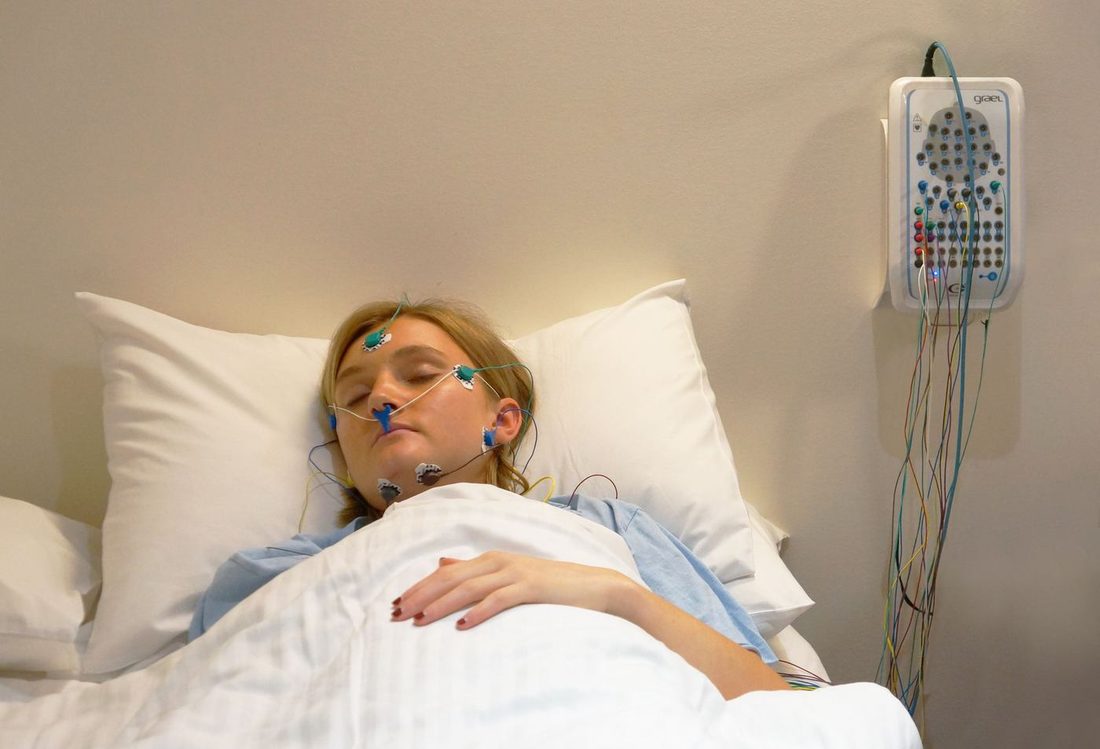
Grael from Compumedics is an amplifier for high-definition polysomnography (PSG); the Grael 4K PSG:EEG is also suitable for EEG. Power and data run over a single network cable (PoE) and the connections for electrodes and sensors are built into the amplifier. Pressing the lever on the docking cradle releases it. The cradle stands on a desk or trolley, or hangs on the wall.
Two versions
- Grael 4K PSG:EEG: sleep study and EEG with the same amplifier. 60 channels, of which 32 referential and 16 differential, with storage up to 4,096 Hz.
- Grael PSG: only the channels for a sleep study. 29 channels, of which 13 referential and 6 differential, with storage up to 2,048 Hz. According to the manufacturer, these are the channels specified for an AASM type 1 study.
Which version suits your department and what can be supplied in your region, we discuss with you beforehand.
Sleep study
The Grael 4K PSG:EEG and the Grael PSG have everything for a full study built in: a light sensor, an oximeter for sleep studies, connections for inductive respiratory belts (RIP), a snoring microphone and a position sensor that needs no calibration. The inputs are DC-coupled and sample at 24 bit. According to the manufacturer, true differential inputs give cleaner signals for ECG and leg EMG, among others, and the Grael meets the digital specifications of the AASM (the American Academy of Sleep Medicine).
EEG with the Grael 4K PSG:EEG
For EEG you connect a Quik-Cap electrode cap to the 32 referential channels of the Grael 4K PSG:EEG. You can link several Grael 4K PSG:EEG amplifiers together. They then synchronise via PTP hardware, for 64 or more referential channels. A virtual amplifier is created in the software. The Grael PSG does not support this linking.
Software and network
For sleep studies you use Profusion Sleep, and with the Grael 4K PSG:EEG also Profusion EEG for EEG. Profusion neXus 360 manages the studies and data in a web environment. The Grael connects to the network, like an IP camera or an IP intercom, which simplifies installation. Which links with your hospital’s electronic health record (EHR) and archive are possible, we discuss beforehand; we set them up together with your application management team and test them before handover.
Expansion and accessories
With the Grael DC you add external signals from other equipment, such as CPAP, tcCO₂ or pH. The Grael also comes with, among other things: disposable and reusable sensors, cables and electrode sets, and a carrying strap for the amplifier. Which sets and sensors suit your situation, we discuss with you beforehand.
Specifications
- Type
- Amplifier for high-definition polysomnography (PSG); the Grael 4K PSG:EEG also for EEG. One box, one cable: power and data over a single network cable, with all connections for electrodes and sensors built in.
- Versions
- Grael 4K PSG:EEG (sleep study and EEG in one amplifier) and Grael PSG (sleep study only).
- Channels
- In total 60 on the Grael 4K PSG:EEG (32 referential and 16 differential) and 29 on the Grael PSG (13 referential and 6 differential).
- Sampling and storage
- Both versions sample at 16,384 Hz. Storage at 256, 512, 1,024, 2,048 or 4,096 Hz on the Grael 4K PSG:EEG; up to 2,048 Hz on the Grael PSG.
- Resolution and inputs
- 24 bit on all channels, DC-coupled inputs. On the Grael 4K PSG:EEG you choose the range per channel: ±150, ±300, ±600 or ±1,500 mV, for lower noise or more permitted DC offset. The Grael PSG has ±300 mV.
- Signal quality
- Referential channels: input impedance above 100 MΩ, CMRR above 100 dB and noise of about 2 µVpp (typical, 0.1 to 70 Hz). Differential channels: the same values, with an input impedance above 20 MΩ. Frequency response DC to 1,150 Hz (adjustable) on the Grael 4K PSG:EEG and DC to 580 Hz (adjustable) on the Grael PSG.
- Respiration
- Both versions: 2 channels for inductive respiratory belts (DC to 64 Hz) and a pressure channel of ±100 cmH₂O (accuracy ±1 cmH₂O at 25 °C). Grael 4K PSG:EEG only: respiratory impedance derived from the ECG electrodes and airflow via a differential input with 2 male luer connectors (±12 cmH₂O, accuracy ±0.6 cmH₂O).
- Position, sound and light
- Three-axis position sensor (supine, prone, left, right and upright), electret microphone for snoring and integrated light sensor, on both versions. Microphone range: 5 to 1,150 Hz (Grael 4K PSG:EEG) or 5 to 580 Hz (Grael PSG), adjustable.
- Oximeter
- Integrated oximeter for sleep studies, on both versions: SpO₂ from 25 to 100%, SpO₂ accuracy 70 to 100% ±2.5 digits (within 1 standard deviation) and heart rate ±1% ±1 digit. Heart rate range: 35 to 300 per minute (Grael 4K PSG:EEG) or 18 to 300 per minute (Grael PSG). According to the manufacturer the resolution is 0.1%.
- EEG connection
- Grael 4K PSG:EEG only: connection for a Quik-Cap electrode cap on the 32 referential channels.
- Linking
- Grael 4K PSG:EEG only: link several amplifiers via PTP hardware (precision time protocol) for 64 or more referential channels; a virtual amplifier is created in the software. Not possible with the Grael PSG.
- Connection and power
- One network cable: 10/100 Mbit Ethernet with PoE to IEEE 802.3af (via a midspan injector or PoE switch), 48 V and less than 10 W. Docking cradle with quick release, on a desk, a trolley or on the wall.
- Dimensions and weight
- 240 × 144 × 50 mm and 700 g, for both versions.
- Environment
- Operating temperature 0 to 40 °C, storage −10 to 50 °C, humidity 20 to 90% (non-condensing), altitude below 3,000 m.
- Standards
- According to the manufacturer: CF patient connections to IEC 60601-1 and IEC 60601-2-26, EMC to IEC 60601-1-2. According to the manufacturer, the Grael meets the digital specifications of the AASM (the American Academy of Sleep Medicine).
- Software
- Profusion Sleep for sleep studies and, on the Grael 4K PSG:EEG, Profusion EEG for EEG, supported according to the manufacturer from Profusion Sleep 4 and Profusion EEG 5. Profusion neXus 360 manages studies and data in a web environment.
- Expansion and accessories
- Grael DC for external signals from other equipment, such as CPAP, tcCO₂ and pH. Also, among other things, disposable and reusable sensors, cables and electrode sets, and a carrying strap.
- Other specifications
- On request. Ask us for the full technical data of this model.
- Source
- Brochures, specification sheets and product pages from Compumedics. Values are the manufacturer’s figures; subject to change. The values for respiratory impedance and airflow, the signal quality of the Grael 4K PSG:EEG and the environment come from the specification sheet of the Grael 4K; for the Grael PSG they come from the manufacturer’s product page.
Documents
Need the datasheet, instructions for use or CE declaration of Grael? We send them on request.
Request documents →IT and network
For your ICT department: what we know from the manufacturer's documentation. We agree the requirements for your hospital with your ICT.
- Operating system and PC requirements
- Profusion EEG 7 is 32-bit; Profusion EEG 8 is 64-bit.
Recommended recording PC according to Compumedics (laptop specification for Profusion EEG 7, November 2023): Windows 10 or 11 Pro or Enterprise (x64), Intel Core i7-6700 3.4 GHz or higher, 16 GB RAM, 1 TB SSD, at least 4 USB ports, 1 Gbit network card, Wi-Fi a/b/g/n/ac with 802.1X.
Software: Microsoft Office 2016 for reports in Word and export to Excel; Windows Media Player for Digital Video.
According to Compumedics, Profusion EEG 7 or higher is supported on Windows Server 2019 and 2022 (Nexus 360 documentation).
Profusion PSG 5 is a 32-bit application and only works with 32-bit Office and the 32-bit Microsoft Access Database Engine (according to Compumedics).
Supported from Profusion Sleep 4 and Profusion EEG 5, according to the manufacturer.
Profusion neXus 360 manages studies and data in a web environment. - Network and Wi-Fi
- One network cable: 10/100 Mbit Ethernet with PoE according to IEEE 802.3af (via a midspan injector or PoE switch), 48 V.
RJ45, auto-MDIX, Cat5e up to 100 m; IPv4 (UDP, TCP, DHCP, ARP, ICMP).
The Grael connects to the network, just like an IP camera or an IP intercom.
You set the IP address (static or via DHCP) and name with the Grael Configuration Utility, version 2.0 or higher.
The Grael must be in the same broadcast domain as the recording PC; the recording PC uses its own network card for the Grael or is on the same network.
Several Grael 4K PSG:EEG amplifiers record as one virtual device, synchronised via PTP (IEEE 1588); all devices must be on the same network switch. - Ports and firewall
- 5705 (UDP and TCP): listens for commands and replies on the designated port.
5707 (UDP): data.
5710 (UDP): sends status broadcasts. - Interfaces (HL7, PACS, ADT)
- We discuss beforehand which interfaces with your hospital's EPR and archive are possible; we set them up together with your application management and test them before delivery.
- Security and updates
- According to the manufacturer's MDS2 form (Grael v2, August 2022): only an RJ45 Ethernet port, no Wi-Fi, Bluetooth or USB.
The Grael does not store patient data.
The firmware is held in non-volatile memory and its integrity is checked at start-up. - Other
- Without the Grael Trolley, the PC, camera and PoE switch or injector must be outside the patient environment (about 1.5 m around the patient or bed).
A full IT checklist for your hospital ICT? Ask us.
Request the IT checklist →About this system
One partner, from delivery to maintenance
We supply, install and maintain the device, and we supply the consumables. That gives you one point of contact for everything around your system.
Installation and instruction
On site, with your team.
Training
The content is stated in the quote.
Inspection and maintenance
We record the arrangements in your quote or service contract.
Remote support
Where your hospital allows VPN or TeamViewer, we can look in remotely.
Knowledge for this system
Other Compumedics systems
Try first
Try Grael first?
One of our colleagues will schedule a demo at your department.