
Nihon Kohden · Patient monitoring
Central station CNS-9101
CNS-9101
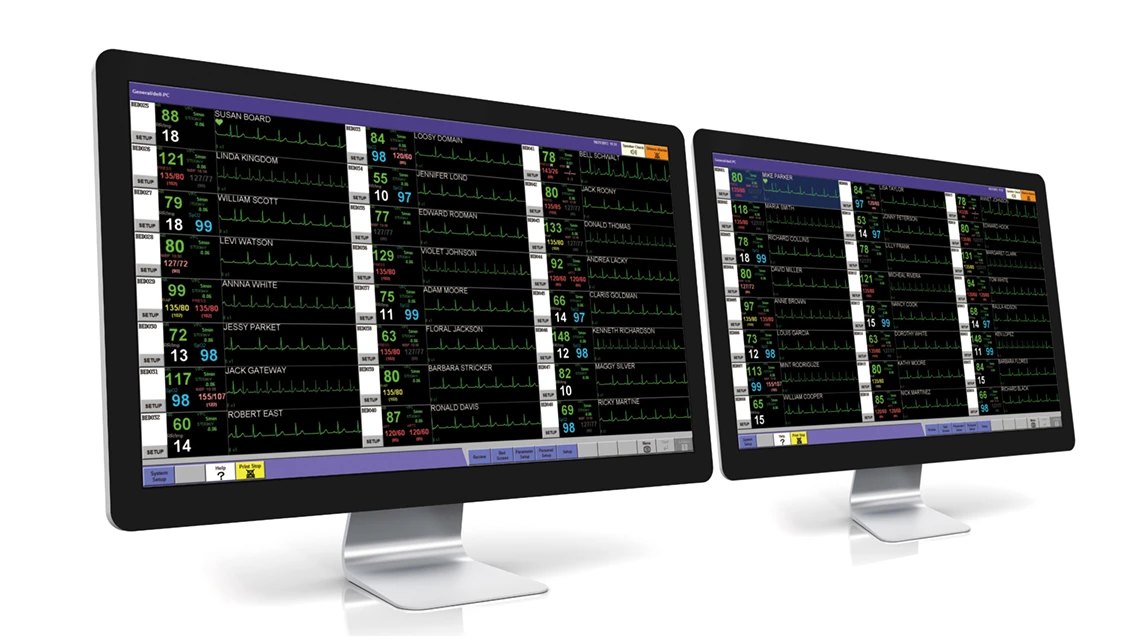
Central nurses' station with 24" colour LCD, up to 16 patients on the screen, 120 hours of full disclosure and alarm types crisis, warning and advisory.
- Display
- 24" colour LCD
- Patients on display
- max. 16
- Full disclosure
- 120 hours, up to 6 waveforms
- Price
- On quote
For owners of this device
Do you have this device?
Choose what you need. We fill in Central station CNS-9101 for you.
The CNS-9101 is a central nurses’ station with a 24″ colour LCD on which up to 16 patients can be shown at the same time; a second screen is optional. The station stores 120 hours of full disclosure for up to six waveforms and shows trends over 1, 8, 24 or 72 hours. Alarms are determined on the bedside monitor and shown on the station as crisis, warning or advisory.
Specifications
- Number of patients on the display
- 16 patients (max.)
- Display type
- 24" colour LCD (second screen option available)
- Waveform display
- Non-fade, fixed method; maximum 24 traces (on the all-beds screen with 12 patients)
- Sweep speed
- 25 mm/s, 50 mm/s, 6.25 mm/s (respiration measurement)
- Waveforms displayed
- ECG, IBP, RESP, CO2, SpO2, others depending on the connected bedside monitor or transmitter
- Numeric data
- Heart rate, VPC rate, respiratory rate, pulse rate, IBP (systolic, diastolic, mean), NIBP (systolic, diastolic, mean), SpO2, temperature; others depending on the connected bedside monitor or transmitter
- Full disclosure
- Stores 120 hours of disclosure waveform data for up to 6 waveforms and shows it in the full disclosure window.
- Trend window
- Trend graph and tabular trend; display times 1, 8, 24 and 72 hours; parameters depending on the connected bedside monitor or transmitter.
- Alarm types
- Crisis, warning, advisory
- Alarm decision
- The alarm is determined on each bedside monitor and multiple-patient receiver; the central station shows the alarm and generates sound based on the alarm information received.
- Vital signs alarm items
- Heart rate, VPC rate, respiratory rate, pulse rate, ST level, BP (sys, dia, mean), NIBP (sys, dia, mean), temperature or ΔT or blood temperature, etCO2, tcPO2, tcPCO2, SpO2, FiO2, CCO; others depending on bedside monitor or transmitter
- Arrhythmia alarm items
- ASYSTOLE, V FIB, V TACHY, EXT TACHY, EXT BRADY, VPC RUN, COUPLET, MULTIFORM, EARLY VPC, BIGEMINY, TACHY, BRADY, PROLONGED RR, FREQ. VPC; plus apnoea alarms
- Alarm display
- Highlighted numeric display; highlighted message for arrhythmia
- Alarm suspend and silence
- Suspend available for beds connected via the QI-910R interface; silence available, except for beds connected via the QI-910R interface.
- Alarm storage and ST recall
- Alarm history: up to 1,000 events per bed. ST recall: 7,200 files.
- Power
- MUC-911RK main unit: 100 to 240 V AC ±10%, 50 or 60 Hz, power max. 230 VA. VLC-911RK main unit: 100 to 240 V AC ±10%, 50 or 60 Hz, power max. 150 VA.
- Dimensions and weight
- Main unit: 93 (W) × 290 (H) × 312 (D) mm, approx. 5.7 kg. LCD unit: 411.9 (W) × 370.1 (H) × 183.3 (D) mm, approx. 5.23 kg.
- Environment (use)
- Temperature 10 to 35°C; humidity 20 to 80% (non-condensing); air pressure 80 to 104 kPa
- Environment (storage)
- Temperature −20 to +55°C; humidity 20 to 90% (non-condensing); air pressure 70 to 106 kPa
Documents
Need the datasheet, instructions for use or CE declaration of Central station CNS-9101? We send them on request.
Request documents →About this system
One partner, from delivery to maintenance
We supply, install and maintain the device, and we supply the consumables. That gives you one point of contact for everything around your system.
Installation and instruction
On site, with your team.
Training
The content is stated in the quote.
Inspection and maintenance
We record the arrangements in your quote or service contract.
Remote support
Where your hospital allows VPN or TeamViewer, we can look in remotely.
Knowledge for this system
Other Nihon Kohden systems
Try first
Try Central station CNS-9101 first?
One of our colleagues will schedule a demo at your department.