
Nihon Kohden · Resuscitation and AEDs
cardiolife TEC-1000
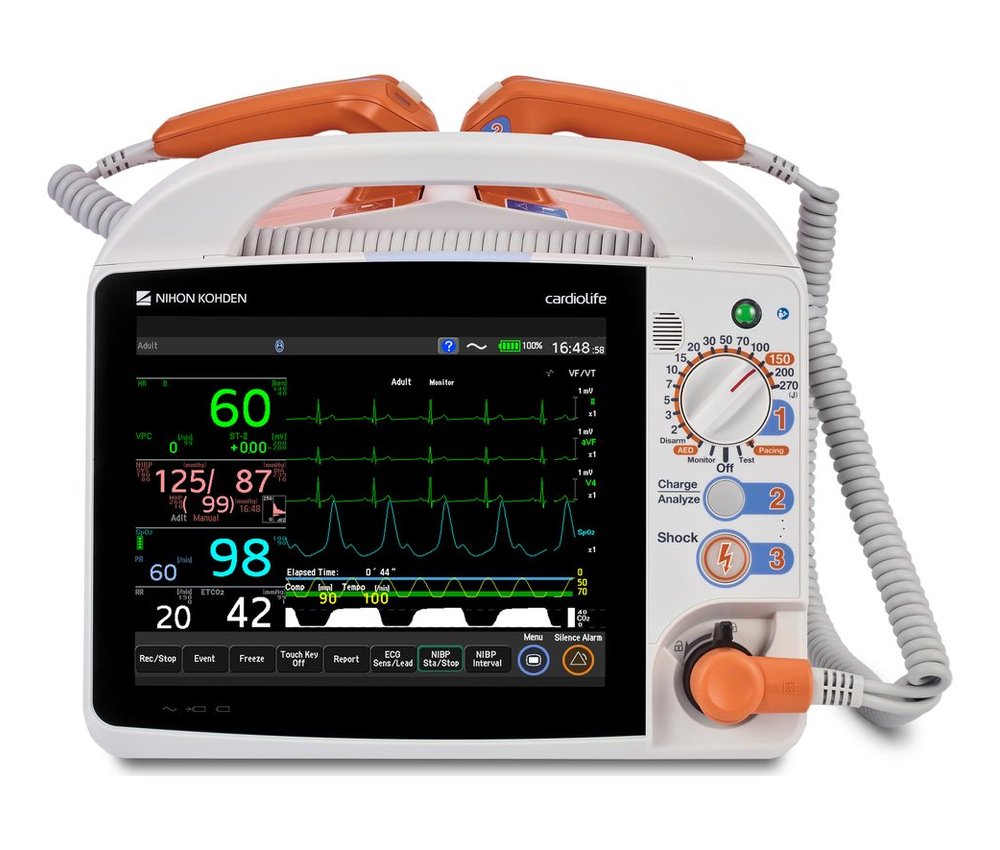
TEC-1021 / TEC-1031
Compact monitor-defibrillator for the hospital, with a 10.4-inch touchscreen: TEC-1021 without pacer and TEC-1031 with pacer. Optional SpO₂, CO₂, NIBP, esCCO and synECi18.
- Energy
- 2 to 270 J
- Screen
- 10.4-inch colour screen
- Battery
- 300 minutes of monitoring
- Price
- On quote
For owners of this device
Do you have this device?
Choose what you need. We fill in cardiolife TEC-1000 for you.
Compact monitor-defibrillator for the hospital
The cardiolife TEC-1000 series from Nihon Kohden is a monitor-defibrillator developed specifically for hospitals: emergency departments, intensive care, rapid response teams and cardiac care areas. The series has two versions: the TEC-1021 without pacer and the TEC-1031 with pacer (transcutaneous pacing, for temporary bradycardia).
The device has a large anti-glare 10.4-inch colour touchscreen, so you reach the main functions directly. You also operate it with a rotary knob. Defibrillation takes three steps.
Defibrillation
- Energy: selectable from 2 to 270 J.
- Fast charging: to 150 J in under 3 seconds with a full battery.
- ECG recovery: within 3 seconds after the defibrillation.
- Application: asynchronous defibrillation, and synchronised cardioversion for atrial flutter, among other things.
AED mode
In AED mode the device charges energy in advance while the rhythm is being assessed, so hands are off the patient for less time. The VF/VT analysis runs continuously in the background, also during chest compressions. According to the manufacturer, Clear Wave Pads give a more stable ECG signal during CPR. For a child aged 6 or younger, use AED mode in child mode.
Measuring
You see the ECG and vital signs on the large screen, with several parameters at once. SpO₂, CO₂ and NIBP are possible with a multi-parameter unit (as an option).
- CO₂: with the cap-ONE sensor, a mainstream sensor without heating. An audible ETCO₂ tone uses five sounds to indicate five ETCO₂ ranges, for example for compression quality and a possible return of spontaneous circulation (ROSC).
- NIBP: with iNIBP, which determines the systolic and diastolic pressure while the cuff is inflating. If the systolic pressure is unexpectedly high, the cuff does not need to inflate again.
- esCCO: an estimated continuous cardiac output (estimated Continuous Cardiac Output), determined non-invasively from ECG, SpO₂, NIBP and patient data (age, gender, height and weight). You follow the trend of cardiac output, stroke volume and haemodynamic stability. A licence is required for this.
- synECi18: a synthesised 18-lead ECG (six extra leads: V3R to V5R and V7 to V9) without extra electrodes. A licence is required for this.
CPR feedback
The device connects to CPR feedback devices from Nihon Kohden and shows the quality of the CPR on the screen. The CPR assist (CPR-1100) gives feedback on the chest compressions and is also a training aid. A wireless LAN module is required for this.
Data and management
- Storage on an SD memory card.
- Report software (defibrillation report viewer) and HL7/FTP communication are available as a licence or option.
- Time synchronisation via NTP for accurate data, and connection to a wireless access point.
- A daily and monthly self-test checks, among other things, the battery, the expiry of the pads and the circuitry. A status indicator shows at a glance whether the device is ready. If you scan the barcode of the pads, the device records the expiry date.
Battery and consumables
A full battery gives 300 minutes of continuous monitoring, or 150 shocks of 270 J. With pacing in fixed mode (180 beats per minute, 200 mA) it gives 180 minutes. When you start using a new battery, write the date on the label; the manufacturer advises replacing the battery every 2 years.
The manufacturer lists disposable pads for adults and children and a battery pack as consumables. A bracket for the bed rail is available as an accessory.
Options and accessories
- Multi-parameter unit with SpO₂ and CO₂ (QI-102V), or with SpO₂, CO₂ and NIBP (QI-103V).
- Wireless LAN module (QI-101V), SD memory card of 1 GB (QM-001D) or 2 GB (QM-002D), report software (QP-551VK).
- Licences for synECi18 and esCCO, HL7/FTP communication (QL-103V) and maintenance communication (QL-104V).
- Battery pack (SB-950P-DB), disposable pads for adults and children (H329), internal paddles (ND-86xV and ND-89xV series).
- CPR assist (CPR-1100), cart (E/CART), bed rail hook (DZ-101V) and a hygienic flat top cover.
Safety and use
The device is intended for medical personnel trained in resuscitation (basic and advanced life support). Do not use it in an MR examination room, in an environment with flammable anaesthetic gas or a high oxygen concentration, or in a hyperbaric oxygen chamber. Always read the manufacturer’s safety information and operator’s manual.
Which options and version suit your department, we discuss with you beforehand.
Specifications
- Versions
- TEC-1021 without pacer and TEC-1031 with pacer (transcutaneous pacing, TEC-1031 only).
- Use
- Hospitals: emergency departments, intensive care, rapid response teams and cardiac care areas.
- Application
- Asynchronous defibrillation and synchronised cardioversion (for atrial flutter, among other things); ECG measurement.
- Screen
- Anti-glare 10.4-inch colour LCD with touchscreen.
- Dimensions
- 333 × 289 × 225 mm (w × h × d).
- Weight
- 6.4 kg, including battery and external paddles.
- Energy
- 2 to 270 J.
- Charging
- Under 3 seconds to 150 J with a full battery.
- ECG recovery
- Within 3 seconds after the defibrillation.
- Operation
- Rotary knob and touchscreen. Defibrillation in three steps.
- AED mode
- Continuous VF/VT analysis in the background, also during compressions. The device charges energy in advance while the rhythm is being assessed.
- Children
- For a child aged 6 or younger, use AED mode in child mode. Do not use it for an adult: the energy may then be too low.
- Battery
- 300 minutes of continuous monitoring, 150 shocks of 270 J, or 180 minutes of pacing in fixed mode (180 per minute, 200 mA). The manufacturer advises replacing the battery every 2 years.
- Measurement (option)
- SpO₂ and CO₂ with a multi-parameter unit (QI-102V) or SpO₂, CO₂ and NIBP (QI-103V). CO₂: cap-ONE sensor; NIBP: iNIBP. Audible ETCO₂ tone with five sounds.
- Haemodynamics (option)
- esCCO: estimated continuous cardiac output from ECG, SpO₂, NIBP and patient data (age, gender, height, weight); trend of cardiac output, stroke volume and haemodynamic stability. Licence required.
- 18-lead ECG
- synECi18: six extra synthesised leads (V3R to V5R and V7 to V9) without extra electrodes. Licence required.
- CPR feedback
- Can be connected to CPR feedback devices from Nihon Kohden, such as the CPR assist (CPR-1100). A wireless LAN module is required for this.
- Data
- SD memory card (1 or 2 GB), report software, HL7/FTP communication (licence), time synchronisation via NTP, connection to a wireless access point.
- Self-test
- Daily and monthly self-test of, among other things, the battery, the expiry of the pads and the circuitry. A status indicator shows whether the device is ready. Scanning the pads records the expiry date.
- Consumables
- Disposable pads for adults and children (H329), battery pack (SB-950P-DB).
- Accessories and licences
- Wireless LAN module (QI-101V), SD card 1 GB (QM-001D) or 2 GB (QM-002D), report software (QP-551VK), licences for HL7/FTP (QL-103V) and maintenance communication (QL-104V), internal paddles (ND-86xV and ND-89xV series), cart (E/CART), bed rail hook (DZ-101V), hygienic flat top cover, CPR assist (CPR-1100).
- Safety
- Only for medical personnel trained in resuscitation. Do not use in an MR examination room, with flammable anaesthetic gas or a high oxygen concentration, or in a hyperbaric oxygen chamber.
- Other specifications
- On request. Ask us for the full technical data of this model.
- Source
- Brochure for the cardiolife TEC-1000 series (E/BR-TEC1000-EN02) and Safety and Performance Information TEC-1021/TEC-1031 (1st edition, 20 June 2025), both from Nihon Kohden. They do not mention waveform, printer, operating or storage temperature, or measuring ranges for SpO₂ and NIBP. The brochure gives the same code (QL-101V) for the synECi18 and esCCO licences, so it is not shown on this page.
Documents
Need the datasheet, instructions for use or CE declaration of cardiolife TEC-1000? We send them on request.
Request documents →IT and network
For your ICT department: what we know from the manufacturer's documentation. We agree the requirements for your hospital with your ICT.
- Network and Wi-Fi
- Time synchronisation via NTP; connection to a wireless access point.
Can be connected to Nihon Kohden CPR feedback devices, such as the CPR assist (CPR-1100). A wireless LAN module is required for this. - Interfaces (HL7, PACS, ADT)
- HL7/FTP communication (licence).
- Other
- Storage on an SD memory card (1 or 2 GB).
Report software (defibrillation report viewer) is available as a licence or option.
A full IT checklist for your hospital ICT? Ask us.
Request the IT checklist →About this system
One partner, from delivery to maintenance
We supply, install and maintain the device, and we supply the consumables. That gives you one point of contact for everything around your system.
Installation and instruction
On site, with your team.
Training
The content is stated in the quote.
Inspection and maintenance
We record the arrangements in your quote or service contract.
Remote support
Where your hospital allows VPN or TeamViewer, we can look in remotely.
Knowledge for this system
Other Nihon Kohden systems
Try first
Try cardiolife TEC-1000 first?
One of our colleagues will schedule a demo at your department.